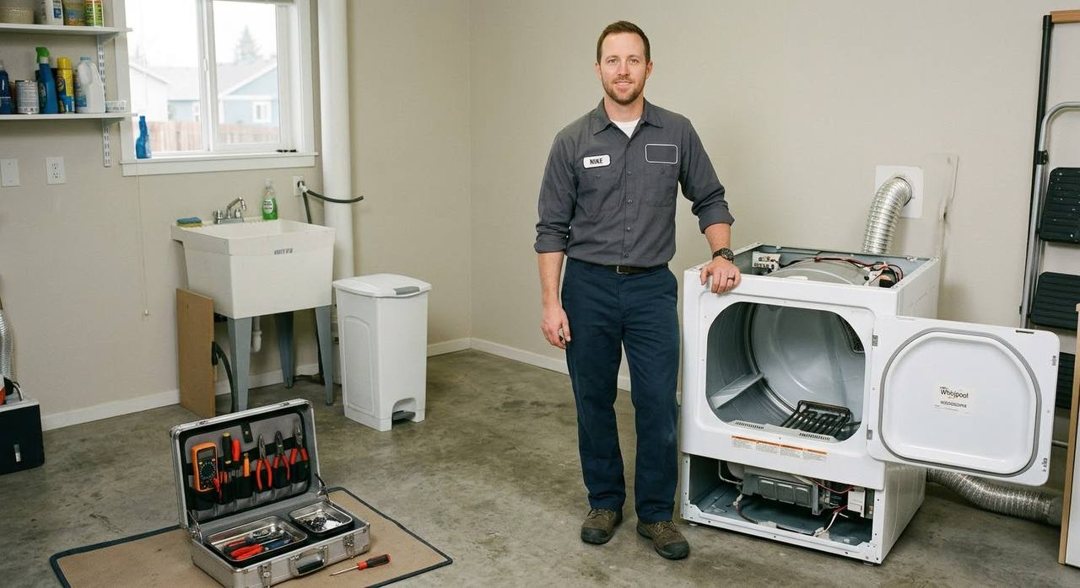
Mitch, on the route
Gig Harbor dryers are, on average, newer and bigger than the ones across the bridge — Harbor Hill and Canterwood laundry rooms run full-size pairs, often gas, with long vent runs through two-story houses to a roof or eave termination.
Gig Harbor dryers are, on average, newer and bigger than the ones across the bridge — Harbor Hill and Canterwood laundry rooms run full-size pairs, often gas, with long vent runs through two-story houses to a roof or eave termination. Roof vents on the peninsula clog with lint and get nested in by birds; a dryer that 'takes forever' up here often has a vent problem thirty feet above the machine.
Down by the harbor the houses are older and the dryers more varied, and the drive down a steep waterfront lot is part of the call. We batch peninsula dryer work into half-days so the crossing never becomes the reason a repair waits.
Two-story Gig Harbor homes vent to the roof; we check the termination before blaming the heat source.
Igniters, flame sensors and gas valves are stocked for the peninsula's gas-dryer majority.
Peninsula calls are grouped so the bridge is a scheduling detail, not a delay.
Restricted airflow — usually a roof or eave vent packed with lint. We measure back-pressure at the machine first.
Igniter or flame sensor most often, occasionally the gas coils. All ride with us over the bridge.
No. The bridge is our scheduling problem. Your written number is for the repair.
Call with the make and the symptom. The written number comes after the diagnosis at your door.
Phones are answered through the working day; the form is for evenings. Either way you hear back with an actual window, not a range of days.
Mon–Fri 8–6:30 · Sat 9–4